

Why Version Control Exists: The Pendrive Problem
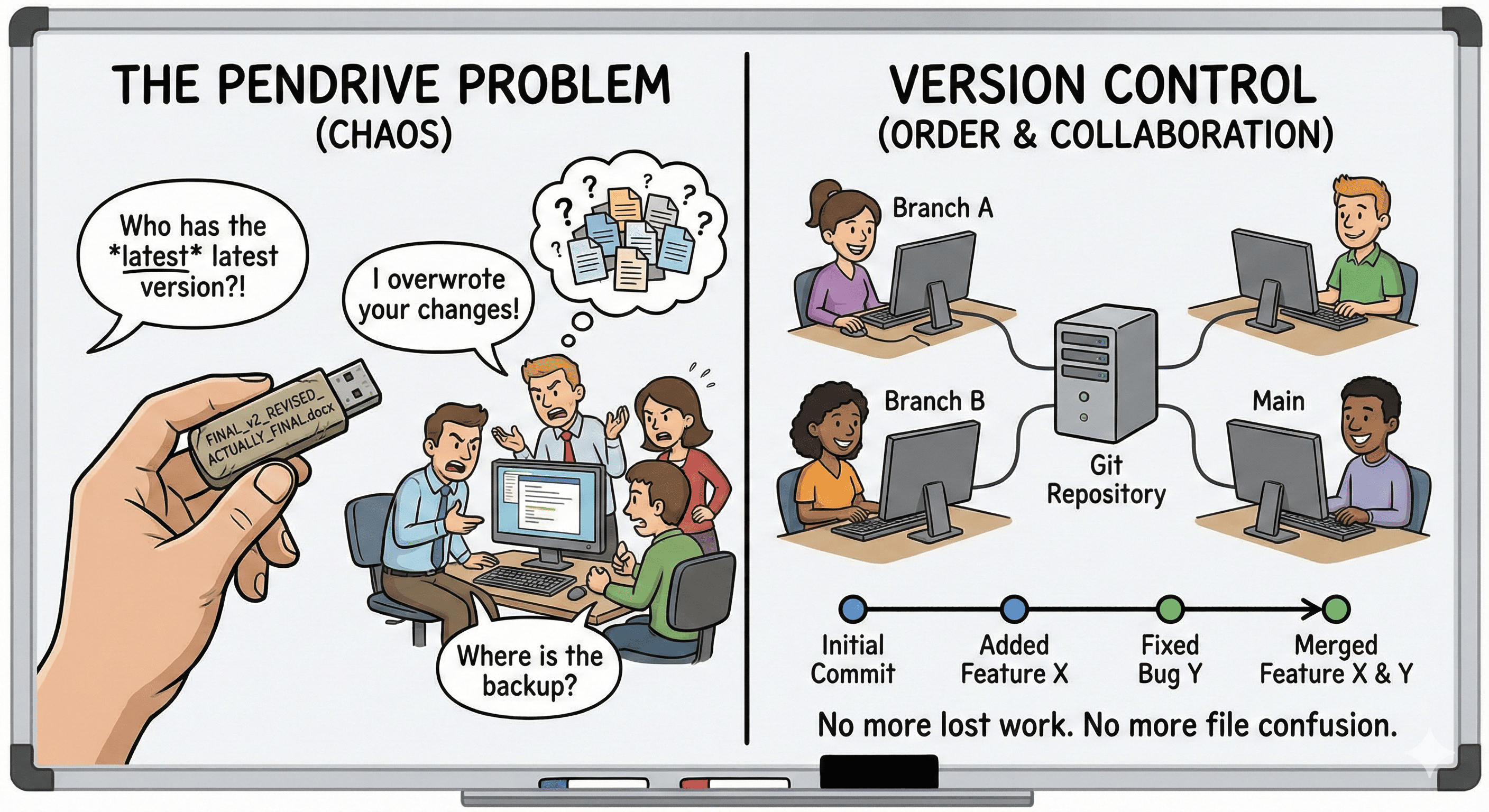
Imagine it’s 2005.
You and three friends are building a website together. You finish your part, copy the entire project folder onto a pendrive, and hand it to your teammate. They add their changes, but accidentally delete half of your code. Panicking, they try to fix it, rename the folder to Project_Final_v2, and email it back to you.
By the end of the week, your inbox looks like this:
Project_v3_updatedProject_v4_REAL_FINALProject_v5_DO_NOT_DELETE
No one knows which version is correct. No one knows what changed. Everyone is afraid to touch the code.
This was software development before version control.
The Pendrive Problem
The “Pendrive Problem” perfectly explains why development used to be painful, slow, and risky. Before tools like Git existed, developers relied on manual file sharing using pendrives, emails, or shared folders.
The Overwriting Trap
Two developers working on the same file at the same time meant disaster. Whoever saved last overwrote the other person’s work. There was no way to combine changes. No merge. No warning. Just lost code.
Hours or even days of work could disappear in seconds.
The “Final_v2” Confusion
Without a system to track changes, developers renamed folders to keep versions:
Project_AlphaProject_Alpha_FinalProject_Alpha_Final_v2Project_Alpha_Final_v2_FIXED
Eventually, no one knew:
Which version was the latest
Which version was deployed
Which version was safe to modify
Fear replaced confidence.
Life Before Git: The Real Problems
Before Version Control Systems became standard, teams faced three major issues that made serious development nearly impossible.
No History, No Accountability
There was no record of who changed what or why. When a bug appeared, there was no way to trace it back to a specific change or person. Debugging felt like guessing in the dark.
Single Point of Failure
If your laptop crashed or your pendrive stopped working, everything was gone. No backups. No recovery. No safety net.
Risky Experimentation
Want to try a new feature? You had to duplicate the entire project folder. If the experiment failed, reverting to a clean, working version was painful and often imperfect.
So most developers simply avoided experimenting at all.
Why Version Control Became Mandatory
As software grew larger and teams became global, the pendrive-and-email workflow completely collapsed.
Developers needed a system that could:
Record every change permanently (commits)
Allow multiple people to work on the same files safely (merging)
Act like a time machine to restore any previous version (checkout)
Protect work from data loss (distributed backups)
This is why Git exists.
And this is why Git is no longer optional. It’s not just a tool — it’s the foundation of modern software development.
In the next post, we’ll go inside Git itself and explore how everything works behind the scenes by understanding the mysterious .git folder.
Happy coding! 🚀
